NOW PLAYING

NOW PLAYING
Emmy® and Golden Globe Award® winner Darren Criss (Little Shop of Horrors) returns to Broadway alongside Helen J Shen in the new romantic musical comedy Maybe Happy Ending.
Inside a one-room apartment on the outskirts of Seoul, Oliver lives a happily quiet life, listening to jazz records and caring for his favorite plant. But what else is there to do when you’re a Helperbot 3, a robot that has long been retired and considered obsolete? When his fellow Helperbot neighbor Claire asks to borrow his charger, what starts as an awkward encounter leads to a unique friendship, a surprising adventure, and maybe even…love?
Winner of the Richard Rodgers Award, Maybe Happy Ending is the offbeat and captivating story of two outcasts near the end of their warranty who discover that even robots can be swept off their feet. Helmed by visionary director and Tony Award® winner Michael Arden (Parade, Once on This Island), with a dazzling scenic design by Dane Laffrey (A Christmas Carol) and book, music, and lyrics by the internationally acclaimed duo Will Aronson and Hue Park, Maybe Happy Ending is a fresh, original musical about the small things that make any life worth living.
HISTORY
David Belasco opened the Stuyvesant in October 1907, having already bequeathed his name on his 42nd St playhouse, now the New Victory. When he relinquished the 42nd St theatre in 1910, he immediately renamed the Stuyvesant as the Belasco. He provided himself with a duplex apartment above the theatre that had the décor of a Gothic church, and housed much of his theatrical memorabilia. Following his death, the theatre was rumored to be haunted by his ghost, until it was banished by the risqué production, Oh Calcutta!. The theatre came under Shubert ownership in 1948.
ARCHITECTURE
Belasco conceived the auditorium of the Belasco Theatre as a living room. He was a proponent of the “Little Theater” movement, which held that the dramatic experience depended partly on the proximity of the audience to the actors, and the shallow depth of the Belasco auditorium accomplishes just that. George Keister was commissioned to design the theatre, with Everett Shinn producing murals (18 of them) and other interior décor. The playhouse is Keister’s earliest surviving theatre; he later designed 12 others, including the Apollo in Harlem. His choice of the neo-Georgian style, often used for residences, complemented Belasco’s desire for theatrical intimacy. The theatre also boasted a state-of-the-art lighting board capable of producing magical lighting effects. With its freight elevator connecting the basement shops with the stage, it set the technological standard for theatre design. In 2010, the historic Belasco was restored to its former grandeur.
Spotlight on Broadway: Belasco Theatre from Spotlight on Broadway on Vimeo.
Details on the Belasco Theatre's Accessibility
Access Information
Access Into Theatre: Theatre is not completely wheelchair accessible. There are 2 steps to box office/lobby. The side entrance has no steps. Please be advised that where there are steps either into or within the theatre, we are unable to provide assistance.
Shubert Audience Services
The Belasco Theatre provides accommodations for patrons who are blind, deaf, partially sighted, and/or have hearing loss. The theatre provides infrared assistive listening devices for every performance at the theatre. In addition, beginning four weeks after a show’s official opening night performance, hand-held audio description devices, hand-held captioning devices, and unlimited access to downloadable audio description and/or captioning for personal mobile devices are all available free of charge. Prior thereto, we offer live-caption via CART using a hand-held device, upon request with two-weeks’ advance notice. For assistance, or If you have questions, contact Shubert Audience Services at 212-944-3700 or audienceservices@shubertorg.com. There is also a representative at the Shubert Audience Services kiosk at every performance to assist any patron with any of our devices, software, or technology. Hand-held devices are limited, although additional devices can be obtained with at least twenty-four hours’ notice.
Accessibility by Seating Section
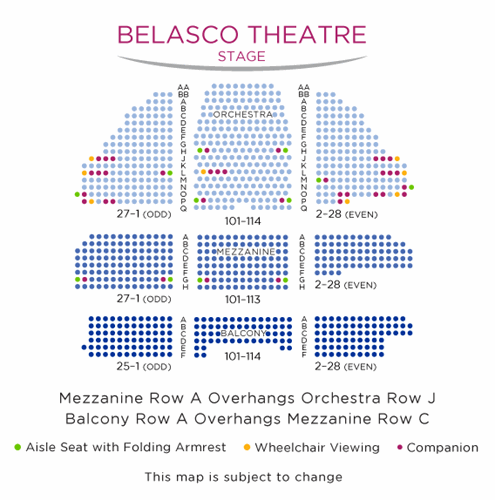
Orchestra Location: Seating is accessible to all parts of the Orchestra without steps. There are no steps to the designated wheelchair seating location.
Mezzanine Location: Located on 2nd level, up 1 flight of stairs. Once on the Mezzanine level, there are approximately 2 steps up/down per row. Entrance to Mezzanine is behind row H.
Balcony Location: No elevator, stairs only. Once on the Balcony level, there are approximately 2 steps up/down per row. The entrance to the Balcony is behind row F.
Handrails: Available at the end of every stepped seat row in the Mezzanine and Balcony.
Wheelchair | Companion Seat Locations:
Orchestra: J23 | J17 - 21; J24 | J18 - 22; L102 | L103 - 105; L25 | L19 - 23; L26 | L20 -24; O24 | O26, N22 - 24; P10 | P8, O8 - 10; P23 | P25, O21 - 23
Aisle Seat with Folding Armrest | Companion Locations:
Orchestra: H101 | H102; H113 | H112; L1 | L3; M2 | M4; P101 | P102; P114 | P113
Elevators/Escalator
None Available
Restroom
Wheelchair accessible restroom available.
Theatre Policies
The use of cameras, recording devices, cell phones, beepers, and other electronic devices during the performance is prohibited, except as permitted for accessibility services. Everyone attending a performance must have a ticket. Latecomers will be seated at the discretion of management. Wheelchair and mobility-impaired seating is intended for patrons with mobility disabilities. Children under the age of four years will not be admitted. No outside food or beverage permitted, unless medically necessary. No weapons permitted on the premises.
| Year Built | 1907 | |
| Seating Capacity | ||
| Orchestra | 527 | |
| Mezzanine | 283 | |
| Balcony | 200 | |
| Boxes | 24 | |
| Standing Room | 25 | |
| Total | 1059 | |
| Included in Numbers Above: | ||
| Orchestra Pit | 24 | |
| Wheelchair | 8 | |
| Aisle Transfer Arm | 12 | |
| Theatre Dimensions | |
| Proscenium Opening: | 38' 9" |
| Height of Proscenium: | 28' 10" |
| Depth to proscenium: | 28' 6" |
| Depth to front of stage: | 30' 8" |
| Stage Type: | Proscenium |